

Open Loop Geothermal, Made Deliverable
Open loop ground source heat pump (GSHP) schemes provide a scalable approach to decarbonisation for large, complex sites with significant energy demand. They offer low-carbon heating and cooling as groundwater is abstracted from aquifers, passed through heat exchangers, and reinjected.
But GSHP schemes also come with risk. Ground conditions are uncertain. Aquifers can behave differently across short distances. Regulatory requirements evolve. And what’s below ground is unknown until you start drilling into it.
TL;DR? Open loop geothermal isn't simply a design exercise; it's a delivery challenge.
This guide explains what happens between feasibility and operation, helping you understand where projects succeed, where they stall, and how to navigate the technical, regulatory and practical realities of delivering low-carbon heating and cooling at scale.
If you're considering open loop geothermal, this page will help you ask better questions, anticipate risks and move forward with confidence.
BUT if you're short on time, send us your site details, outline design or simply tell us what you're trying to achieve.
We'll take an initial view on whether open loop geothermal is likely to work, where the key risks may sit, and what the next steps could look like.
The reality is that change is expected on complex geothermal schemes. Ground conditions vary, constraints emerge and assumptions are tested. The question isn't whether challenges will arise, but whether they're identified early and managed effectively, or discovered later when options are limited and costs escalate.
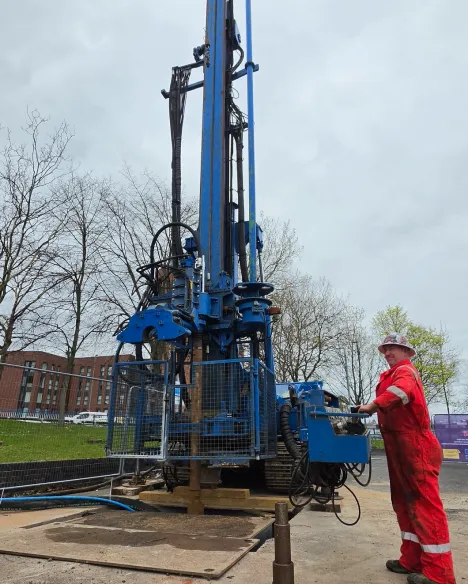
Drift supports open loop geothermal schemes from early feasibility through to delivery, acting as Principal Contractor or specialist delivery partner. We work at the critical interface between design and delivery - bringing practical drilling expertise, coordination and problem-solving capability to ensure projects move forward with confidence, risks are understood and costs are controlled.
Trusted to deliver for these organisations





Turning Open Loop Geothermal Design into Real-World Delivery
Successful geothermal schemes depend on more than good design. Discover how practical expertise turns ambitious concepts into operational systems.
A GSHP scheme’s design sets the intent, but delivery determines whether the design works. We’re brought in to bridge that gap, working alongside clients, consultants and regulators to translate a design into a scheme that can be built, tested and operated successfully.
That can mean challenging assumptions early, before they become programme or cost issues. It also means understanding how ground conditions, infrastructure and constraints will affect what’s possible. And it means responding in real time during delivery, when conditions inevitably don’t always match what was expected.
We bring practical drilling expertise across all UK ground conditions, and we connect experience with design, hydrogeology and on-site delivery. Because open loop geothermal schemes don’t fail in concept. But they can fail when design and delivery aren’t aligned. Our role is to keep them aligned so projects move forward and stay deliverable.
If you want to understand what that looks like in practice and in more detail, we have a step-by-step guide to Open Loop Geothermal Project Success.
Let's discuss your project.
Evidence over assumptions.
Engineering over optimism.
Confidence before commitment.
How this works in practice:
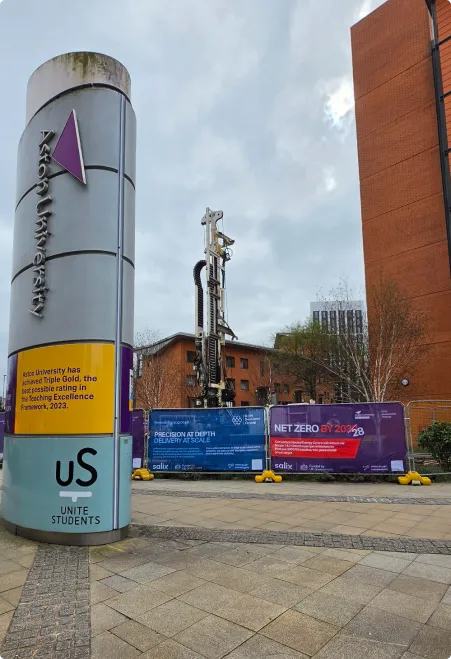
Aston University's ambitious decarbonisation programme demonstrates how open loop geothermal can be successfully delivered in a complex, live environment.
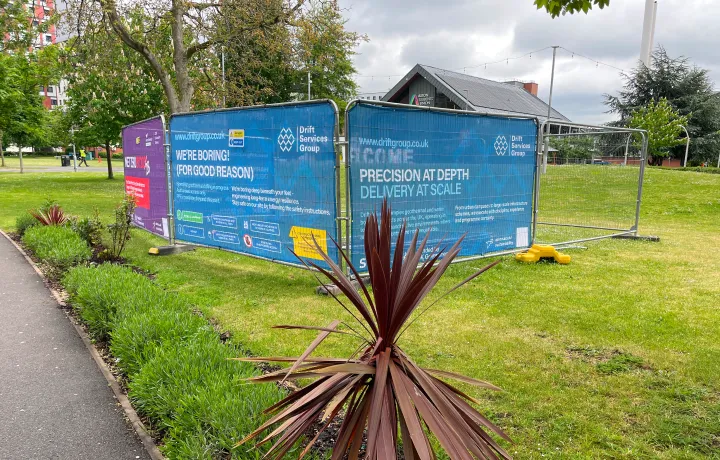
Drift is Principal Contractor on a £35.5 million decarbonisation scheme at Aston University which forms the centre of its Energy Resilience Programme. The scheme comprises twelve boreholes targeting the Sherwood Sandstone aquifer, each drilled to depths of up to 195 metres and configured as six abstraction and six reinjection wells.
This is not a controlled site; it’s a fully operational university campus. It’s busy, constrained and constantly changing. During delivery, unknown services and buried structures have been identified in real time. Borehole locations have had to be adapted dynamically. Ongoing coordination with regulators and stakeholders has been critical.
Drilling is only part of our job, the rest is making plans work on a live site, with real constraints, ensuring open and effective communication – and making it all look easy!
Planning something similar? Let's talk.
Where open loop geothermal makes sense
Understanding the characteristics of successful projects can help determine whether open loop geothermal is a viable option for your site.
Open loop geothermal tends to work best where scale, demand and constraint come together. That often means environments where energy is not a single-building decision, but part of a wider system: heat networks, campuses, industrial sites, data centres, or large residential developments.
In these environments, the question is rarely “can we install a low carbon system?” It’s “what will work here, at this scale, under these conditions?”
Where site conditions support the ambition, open loop geothermal becomes one of the most effective low-carbon heat sources available. Where they don’t, it quickly becomes unviable. That reality is best established early to either shape the design or confirm it’s not the right solution.
And open loop geothermal is not your only option, and it’s not always the right one. What matters is understanding how it compares in real terms, based on your site, your demand and your constraints. If you’re weighing different approaches, see our guide: Open Loop vs Closed Loop vs Air Source Heat Pumps.
The question isn't whether open loop geothermal is a good technology.
It's whether it's the right technology for your site.
Send us your site details and we'll help you understand what's viable, what's not, and what needs to happen next.
How Long Do Open Loop Geothermal Projects Take?
Learn how long open loop geothermal projects typically take, including design, permitting, drilling, testing and installation.
Open loop geothermal projects are not quick. From early feasibility through to operation, most schemes take months to years, not weeks.
That’s not because the technology is slow. It’s because the process involves several stages that can’t be rushed:
- understanding the ground and proving the resource
- securing regulatory approvals for abstraction, testing and discharge
- designing a system that works under real conditions
- and delivering it safely on site
Even relatively straightforward schemes often take around 18 - 24 months from concept to operation. More complex or constrained projects can take longer. The key point is not the exact timeline. It’s whether the programme reflects reality.
Projects that underestimate timescales tend to come under pressure later, particularly around testing, licensing and site constraints. Projects that plan for them properly tend to move forward with fewer delays and fewer surprises.
What we see when we walk your site
Discover how early site assessments help identify risks, inform geothermal feasibility and improve project outcomes.
We don’t start with a model. We start with your site.
You might point to a patch of ground and say, “one of the boreholes will go there.” We’ll see the manhole covers and know there are services running through it. That doesn’t stop the scheme, but it might change how it needs to be delivered.
We might recognise a nearby high-water user like a hospital or a hotel. That can affect abstraction, monitoring and liaison requirements.
You show us a car park…we see the need for secure compound space, so access isn’t blocked mid-programme. Show us a busy road to exit onto and we see traffic management, safe access and the need for a banksman.
We’ll also be thinking about what isn’t visible: buried utilities that need confirming, potential unexploded ordnance risk, ground conditions that don’t match the records, and the surveys needed to de-risk all this.
None of these are problems. But they could be constraints, and they certainly need to be understood early. Because once the design is fixed, your options narrow. But when challenging factors are considered upfront, a design and a programme can respond to them and a project can move forwards with fewer surprises, fewer delays, fewer cost variations and far less rework.
If you want to understand the regulatory and environmental constraints that also shape delivery, see our guide to Licensing, Regulation and Environment Agency Requirements.
Make informed decisions
Access the knowledge and expertise needed to evaluate open loop geothermal solutions with confidence
If you’re considering open loop geothermal, the most valuable step is early-stage reality checking. Because by the time drilling starts, most of the critical decisions have already been made, sometimes on incomplete information.
We can get involved before that point, bringing a delivery-led view of what will actually work on your site, under real conditions. This is particularly important where projects are being shaped around UK decarbonisation funding or loans, where timelines, eligibility and deliverability all need to align.
We’ll help you understand what’s viable, where risk sits, and what needs to happen next. Book a feasibility discussion, or send us your site and we’ll take an initial view.
Drift Services Group: specialist drilling and delivery for complex geothermal and water borehole projects across the UK.
FAQ
- Is open loop geothermal suitable for every site?
No. Open loop systems rely on the presence of suitable groundwater resources and favourable hydrogeological conditions.
Factors including aquifer productivity, groundwater chemistry, environmental constraints and site layout all influence viability. Early-stage feasibility work is designed to establish whether open loop geothermal is the right solution before significant investment is made.
- How deep are open loop geothermal boreholes?
Boreholes may range from tens of metres to several hundred metres depending on geology, the required yield and the heating or cooling demand of the development.
At Aston University, for example, boreholes were drilled to depths of up to 195 metres into the Sherwood Sandstone aquifer.
- How long does an open loop geothermal project take?
Most schemes take 18 - 24 months from initial feasibility through to operation, although complex, deep projects can take a lot longer. Timescales are often influenced by regulatory approvals, testing requirements, procurement routes and the operational constraints of the site itself.
- Is open loop geothermal more efficient than closed loop systems?
Open loop systems can achieve very high efficiencies because they utilise the relatively stable temperature of groundwater directly. However, they are not suitable everywhere.
The best solution depends on site-specific factors, available land, groundwater conditions and project objectives.
- Do I need an Environment Agency permit?
Yes. Open loop geothermal schemes require licences relating to groundwater abstraction, reinjection, discharge and testing activities. Regulatory requirements vary depending on the scale and nature of the project, making early engagement important.
- What happens if ground conditions aren't what was expected?
Unexpected conditions are common in subsurface projects. The key is identifying and managing change effectively.
Experienced delivery teams adapt drilling methodologies, equipment, borehole designs and programmes in response to real-world conditions while maintaining project objectives.
- Can open loop geothermal be delivered on a live site?
Yes, many projects are delivered within operational environments such as hospitals, universities and commercial campuses. Careful planning, stakeholder communication and flexible delivery approaches are essential to minimise disruption while maintaining safety and programme certainty.
- What are the biggest risks associated with open loop geothermal projects?
The principal risks tend to relate to hydrogeological uncertainty, regulatory approvals, buried infrastructure, programme assumptions and constructability. Most of these risks can be reduced significantly through early investigations and delivery-led feasibility assessments.
- When should a drilling contractor become involved?
Earlier than many people realise. By the time drilling begins, many of the decisions that shape project success have already been made. Early contractor involvement helps ensure that designs reflect the realities of construction, testing, access and operational constraints.
- How do I know whether open loop geothermal is worth exploring?
If your organisation has significant heating and cooling demands, long-term occupation of a site and ambitious decarbonisation targets, it's often worth having an initial conversation. An early feasibility review can quickly establish whether the opportunity merits further investigation.
Still have questions?
Every geothermal project is different.
If you'd like an initial view on whether open loop geothermal could work on your site, send us your site details, outline design or simply explain what you're trying to achieve. We'll help you understand what's possible, where the risks may sit and what the next steps could look like.